This article is published in the Astrological Journal May/June 2026 Issue.
We live in a culture that treats sexual fervour as a necessity of life. But what if you don’t feel that urge?
Everywhere we look – from films and wellness advice to dating apps and relationship columns – the message is clear: if you don’t want sex, something must be wrong with you. A lack of sexual desire is regarded as a problem to fix, a symptom to medicate, or proof that a relationship is failing.
Well, here’s the thing: not everyone is wired the same way. Just as we differ in temperament and emotional needs, we also differ in libido. Some of us have an innately high sex drive, some of us experience desire intermittently or mildly, and some feel little or no sexual urge at all. These differences are natural, not defects.
Sex, in other words, exists on a spectrum. For some, it’s central to their sense of connection; for others, emotional intimacy, intellectual bonding, spiritual focus, creativity, or shared companionship matter far more.
Nevertheless, fuelled by the media, society – whether straight or LGBTQ+ – assumes that everyone should be sexually active until they are in the grave and life without regular sex is not just incomplete, it’s broken.
Nonetheless, the obsession with sexual activity is increasingly being challenged by younger generations. Terms like ace (asexual), greysexual, or demisexual describe relationships with sexuality that don’t fit the old paradigms, and communities are forming to support people who challenge conventional expectations.
To give an example, during a 2019 interview with British Vogue, Harry Potter star Emma Watson (then aged twenty-nine) described herself as ‘self-partnered,’ explaining that she was content being single and has worked to be happy on her own rather than feeling pressurised to ‘marry’ as many of her peers were doing. According to recent media reports, she remains ‘focused on her life, education, and career rather than conforming to conventional relationship milestones.’i
So, how can astrology help us to understand our relationship with sexuality?
Astrology reflects variations in desire through planetary placements, signs, aspects, and energetic influences, revealing a far more complex story about our relationship with sex than society or the media often lead us to believe.
For example, some Sun signs are considered more sexually driven than others, but this comes with an important caveat. To truly understand sexuality, the entire birth chart has to be taken into account. A Sun sign that appears ‘less sexual’ does not imply less intimacy, love, or fulfilment. It simply means that desire is expressed in a different way.
Often seen as more sexual and sensual:
- Scorpio: Intense, magnetic, erotic, all-or-nothing energy. Sex, power, bonding, transformation.
- Aries: Raw libido, impulsive, physical, turned on by the chase.
- Leo: Passionate, playful, loves attention; sex as affirmation.
- Taurus: Deeply sensual, physical, slow, consistent.
- Sagittarius: Adventurous, curious, experimental; sex as freedom and fun.
More emotionally focused:
- Cancer: Needs emotional safety first; body follows heart.
- Pisces: Erotic in a dreamy, emotional, or spiritual way; less about frequency, more about merging.
- Libra: Sexual through connection and attraction; more romantic than raw.
Less overtly sexual:
- Gemini: Turned on by the mind; curiosity is libido.
- Virgo: Can be sexual but controlled, selective, and private.
- Aquarius: Detached, unconventional; intimacy doesn’t always equal sex.
- Capricorn: Reserved, disciplined; desire often buried under control, ambition, or timing, yet unmistakably the dark sea-goat of sexuality.
Venus and Mars
It helps to clarify what astrology is describing when it speaks about sex, desire, and intimacy. A chart does not measure sexual behaviour, frequency, or satisfaction. It shows how desire is experienced, what may feel blocked or missing, and where tension might arise.
While the Moon rules our moods and emotional responses, including how we experience intimacy, the two planets most directly associated with love and sex are:
- Venus: Governs attraction, bonding, values, and pleasure. Venus reveals what feels desirable, who we are attracted to unconsciously, how we express affection, and what creates charm, beauty, and emotional reward in the connections we make.
- Mars: Represents libido, instinct, and pursuit. It shows how desire is expressed, how we go after what we want, and how sexual energy is conveyed physically and assertively. Mars is about drive and action, not necessarily pleasure.
When Mars and Venus form easy aspects, sexual expression tends to flow naturally. Hard aspects, on the other hand, can create inner tension, conflict, impulsive desire, obsession, or mismatched libido.
But it’s the conjunction between Venus and Mars that can be the most complex. According to astrologer Sonya Schwartzii, the conjunction blends the energies of desire (Mars) and attraction (Venus) within an individual, often creating a strong sexually magnetic presence (or the ‘it’ factor) and an integrated expression of how to relate emotional and sexually.
This internal fusion tends to foster a sense of wholeness in love and desire, reducing the need for constant external validation from a partner, though, of course, how this plays out depends on the sign, house placement, and additional chart aspects. Nevertheless, people with this conjunction are often drawn to partners who match their intensity, yet over time they may become less reliant on a relationship to feel at ease with themselves.
This does not indicate avoidance of love, but rather a balance between giving and receiving that supports emotional and sexual self-sufficiency. In my work with clients who have a Venus/Mars conjunction, it’s interesting to see how some either choose to remain single or, even in a relationship, experience period of sexual abstinence not because they don’t want intimacy, but because they don’t need a sexual relationship to feel complete in their emotional expression, particularly as they mature.
All planets carry sexual energy to some degree
It’s important to note that all planets carry sexual energy to some degree. Mercury, for example, influences how we think about sex. A strong Mercury placement can show up as curiosity, flirtation, or a preference for mental stimulation over physical intimacy, sometimes manifesting as voyeurism, fantasy or pornography.
Jupiter, on the other hand, magnifies whatever it touches, expanding desire, attraction, and the search for pleasure. In sexual terms, a strong Jupiter can bring enthusiasm, adventurousness, and a love of exploration, encouraging openness to new experiences and a generous, expansive approach to intimacy. At its extreme, Jupiter can contribute to overindulgence or a tendency to seek pleasure compulsively – usually from enthusiasm rather than a deep plutonic psychological compulsion. The Jupiter-sexual archetype is Cassanova – endlessly charming, playful, and passionate, drawn to variety and pleasure, who may not make a great long-term partner but is a magnetic and exciting lover.
Saturn represents the opposite: inhibition and containment. In the 5th house of romance and personal pleasure, Saturn can delay or discipline desire, often bringing responsibility, fear, or shame into someone’s approach to intimacy. It doesn’t erase sexuality but requires patience and maturity before intimacy feels safe. In the 8th house, which governs shared intimacy and emotional transformation, Saturn symbolises a more cautious, regulated approach to sexual and emotional closeness. Desire may feel intense but controlled, and intimacy typically develops slowly as trust and courage are developed over time.
Uranus does not create desire itself but rules freedom, unpredictability, rebellion, and innovation. So, a strong Uranus in the 5th house, for example, can bring excitement, experimentation, and draw unconventional lovers. Sex under Uranus can feel electric and liberating, but sudden attractions can quickly fizzle, and the concept of commitment can be challenging if not alarming.
Pluto intensifies everything it touches, bringing compulsion, obsession, power dynamics, and the drive toward total experience – and in some cases, sexual addiction. It demands depth, often through intensity or crisis. Hard Pluto aspects to Venus or Mars can make sexuality feel consuming and fraught with tension. For example, Pluto opposing Venus may trigger jealousy, possessiveness, or intense fear of loss, while Pluto square Mars can make sexual drive overwhelming or manipulative. These aspects invite profound transformation but navigating them requires conscious effort to prevent this intensity from becoming destructive.
Marilyn Munroe
Neptune governs idealisation, fantasy, longing, and transcendence. A strongly placed or aspected Neptune can elevate desire into glamour and myth, but also blur reality, leading to confusion, illusion, or disappointment.
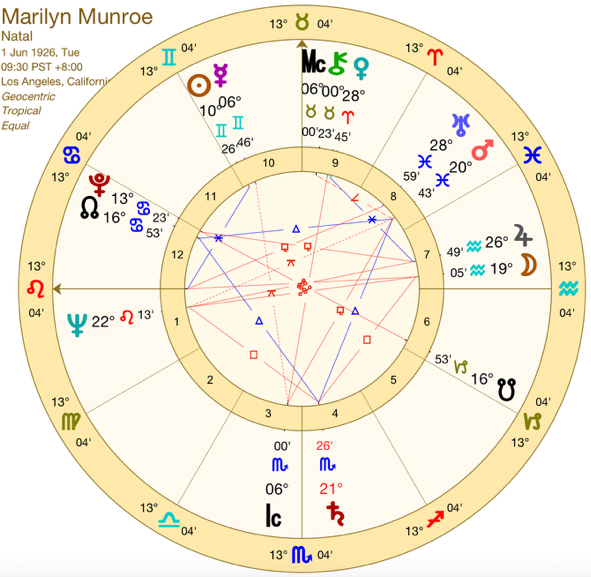
Marilyn Munroe’s chart (source Astro.com using Equal House) is a perfect example of this. Her grand trine in water creates effortless emotional magnetism which draws people in. The fixed T-square signatures reflect immense glamour, projection and erotic idealisation, making her a global symbol of desire (Neptune in Leo 1st house opposite Moon and Jupiter in Aquarius 7th). Yet her lived experience of intimacy was deeply complicated (T-square apex Saturn in Scorpio, 4th house), marked by insecurity, longing, and emotional fragility.
This shows how astrology reveals the currents beneath the surface, not guarantees of pleasure. Marilyn’s chart reveals the patterns along which her longings moved throughout her life, rather than promising sexual satisfaction or happiness.
When sex isn’t central
When sex is not a dominant theme in a chart, astrology offers a more nuanced picture. Sex, in these cases, isn’t missing or denied, it’s simply not ruling the psyche. Desire exists (we all carry Mars energy), but it does not demand constant expression.
One of the clearest signatures of this pattern is Mars in hard aspect with Saturn. When Saturn aspects Mars, sexual drive often has the brakes on, caused by an underlying sense of responsibility, caution, discipline, or fear. This does not remove libido, but it slows it down, matures it, and perhaps redirects it into something manageable. Desire may become private, conditional, or expressed only when there is trust, stability, or purpose. Saturn asks Mars to mean something rather than just the sexual act.
Mars placement by sign also matters. For example, in Virgo, Mars tends to express itself through usefulness, service, or improvement. Desire becomes selective, sometimes critical (of self and others) and usually practical. Pleasure, therefore, tends to be filtered through effort and discernment rather than indulgence.
To give another example, when Mars is in Capricorn, sexual energy is expressed strategically, focused, and purposeful rather than impulsive. Passion is often channelled into creating and building, whether establishing a secure home, advancing a career, or nurturing long-term relationships, turning desire into tangible achievement. While Capricorns may appear reserved, their sexuality is deep, serious, and enduring, capable of profound intensity once they feel secure enough to express it. Having said that, Capricorn does carry the dubious reputation of the being the randy old goat!
When Mars is in Pisces (the archetype of the spiritual warrior), sexual energy is fluid, sensitive, and often indirect. Desire is influenced by imagination, emotion, and empathy, rather than direct physical assertiveness. Sexual expression can be dreamy, romantic, or spiritual, but also elusive or easily diffused, so sexual impulses can be inhibited by fear, idealisation for the perfect partner, or uncertainty. People with this placement may avoid confrontation or overt pursuit, preferring subtle seduction or fantasy. Mars in Pisces emphasises sensitivity, intuition, and emotional connection, sometimes at the expense of clear, direct sexual expression.
Element and houses
Charts heavy in Earth or Air can appear less driven by sexuality, but for very different reasons. Strong Earth is deeply sensual, valuing touch, comfort, and physical satisfaction, yet it often expresses desire in a contained, steady, or private way rather than impulsively. Strong Air, by contrast, prioritises thinking, communication, and perspective, and may experience sexuality more mentally than physically, which can make pleasure seem secondary to ideas or connection. Again, desire is not absent – it is simply filtered through practicality in Earth charts and intellect in Air charts, rather than expressed through the emotional intensity of Water or the instinctive, expressive passion of Fire.
Another key indicator of lower passion is a weak emphasis on the 5th and 8th houses. When these houses are empty or lightly aspected, erotic play (5th) and sexual intimacy (8th) may not feel central to identity. In other words, romance, sexuality, and intimacy are not defining areas of self-discovery. The drive to build, help, think, or contribute can outweigh the drive to pursue sexual pleasure for its own sake. Desire may exist, but it is integrated into daily life rather than isolated as a priority.
The 12th house should also be considered, as it governs what is hidden, unconscious, and deeply private within a person, encouraging inward reflection and a more internalised experience of life. When sexuality is connected to the 12th house, desire is often experienced inwardly rather than expressed openly. It can be influenced by fantasy, imagination, and unspoken longings, with a tendency to keep attractions or relationships confidential. Intimacy may feel emotional, spiritual, or even karmic in nature.
When Venus or Mars are placed in the 12th house, love and desire take on a more private, subtle, and sometimes secretive tone. Venus here may romanticise hidden relationships or long for unconditional, almost otherworldly love, while Mars can express desire indirectly, through fantasy or behind-the-scenes dynamics.
A dominant Neptune or a spiritually oriented Saturn (in Pisces or 12th house) tend to channel their sexual energy into intellectual, creative, or spiritual pursuits. Neptune adds idealism and sensitivity, and Saturn provides discipline and structure, creating the conditions for consciously restraining sexual impulses and focusing on mastery or higher goals.
Overall, planets in the 12th house can point to unconscious patterns in love and attraction, including self-sabotage or being drawn to unavailable partners. At its highest expression, however, 12th house sexuality is transcendent – intimacy becomes a surrender of boundaries and a profound emotional and spiritual merging.
Keanu Reeves
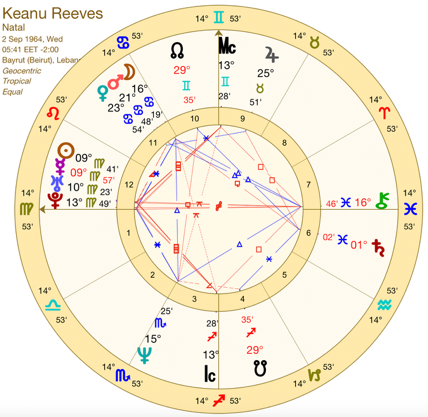
With no fire element, no planets in 5th and 8th houses and a strongly populated 12th house, Keanu Reeves’ chart (source Astro.com) in Equal House reflects someone who has spent long stretches of his adult life single, celibate, and intensely private (12th house Sun, Mercury Uranus, Pluto Virgo stellium).
Strong Virgo and Cancer signatures suggest he naturally processes attraction inwardly, valuing thoughtfulness and privacy over outward expression. His Cancer Moon, Venus, Mars stellium adds emotional depth, sensitivity and considerable sexual allure, while its harmonious relationship with Neptune supports idealisation, compassion, and the way he channels feelings into artistic work rather than overt sexual or romantic expression. Despite public success as a Hollywood heartthrob, his chart consistently suggests someone who values privacy, restraint, and an intensely lived inner life.
This quiet approach is reflected in how he responded to the death of his child and eighteen months later, the death of his ex-partner by choosing to withdraw, live simply, and supporting cancer research and children’s hospitals (Chiron conjunct descendent opposing his 12th house Virgo stellium). It also reflects his low-key yet committed relationship with artist Alexandra Grant, with only occasional public appearances.
When Sexual Attraction Is Minimal or Absent
Astrology can also offer insight into why some people experience minimal sexual attraction without implying trauma or dysfunction. In fact, astrologically, low sexual drive, or asexuality, is often a natural orientation, not a deficit.
A common indicator is limited or challenging Mars/Venus aspects. For example, when Mars and Venus form quincunxes, sesquiquadrates, or remain largely unconnected by major aspects, the usual exchange between desire (Mars) and attraction or pleasure (Venus) can be misaligned or operate independently.
Rather than expressing sexual desire in conventional ways, people may channel energy into creativity, mentorship, intellectual pursuits, or service. In astrology, these minor aspects are often called ‘blind spots’ on the desire-attraction axis: the energy exists but does not flow with ease, or at all.
Uranian signatures frequently appear in these charts, highlighting unusual approaches to identity and relationships. For example, a strong Uranus placement on the angles or aspects to personal planets suggest sexual expression, if present, may be selective, unconventional, or fluid and erotic desire is not central to self-definition. These signatures often indicate comfort with being different and self-defining outside traditional sexual norms.
Saturn and Air dominance can also contribute. Saturn tempers drive, promotes deliberation, and shifts focus towards self-mastery, responsibility, or intellectual pursuits. An Air-dominant chart emphasises ideas, communication, and conceptual connection, favouring intellectual intimacy over sexual expression.
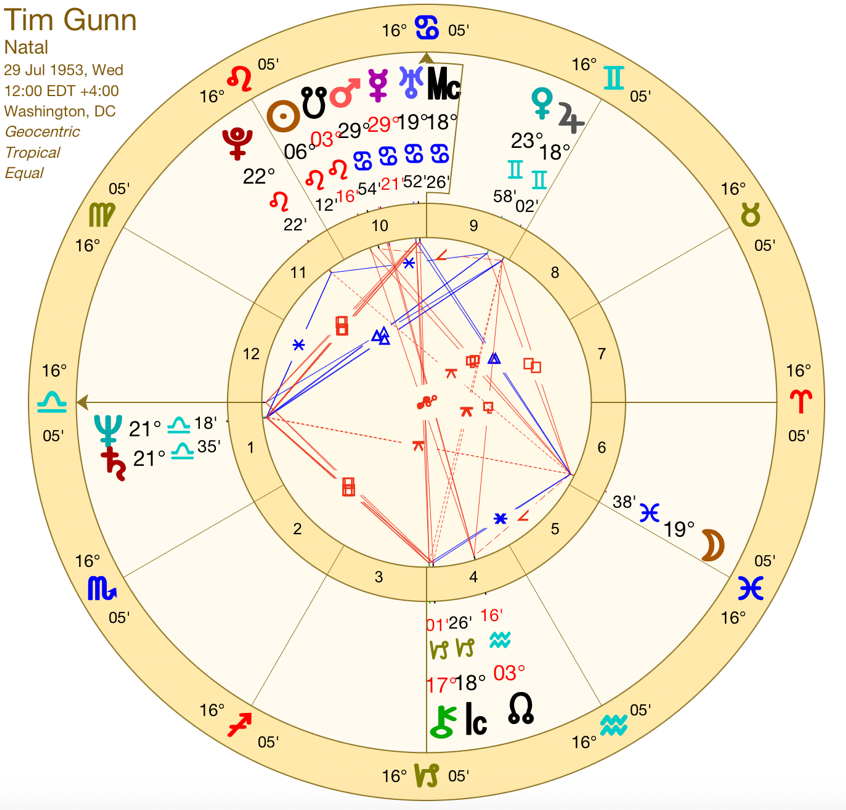
An example is Tim Gunn (birth time not publicly known, source: myastro.com using Equal House), the American fashion consultant, educator, and mentor on Project Runway, who is openly asexual. His chart offers insight into how fulfilment, creativity, and influence can flourish independently of sexual desire.
Born with the Neptune/Saturn conjunction which expresses generational ideas of beauty and artistic expression, Gunn’s Venus and Mars are in a challenging semi-square, suggesting a tension between desire and action. He has a prominent stellium led by Sun in Leo conjunct the South Node while Mercury and Mars are at 29° Cancer and Uranus at19° Cancer. Together, the stellium shows a blend of creative authority (Sun), intellectual and communicative mastery (Mercury), purposeful action (Mars), and unconventional innovation (Uranus).
I think it’s also interesting to consider how his Moon in Pisces is notably afflicted, including squares to Venus and Jupiter, and a sesquiquadrate to the Sun. This subtle underlying emotional tension combined with a lack of Earth planets but a strong Air emphasis, suggests he channels his energy toward intellectual and creativepursuits, mentorship, and personal influence rather than sexuality. In fact, it’s an interesting example of how an afflicted Moon can still produce fulfilment, but through unconventional outlets (Moon tight trine Uranus).
Celibacy, Spirituality, and Conscious Abstinence
Celibacy and conscious abstinence also reflect a redirection of sexual energy rather than its absence. Although his birth time is not known, a clear example is Isaac Newton (source Astrotheme.com using Equal House) with his Capricorn Sun highlighting discipline, responsibility, and long‑term focus on work and mastery of material reality.
Capricorn energy prefers structure and achievement to casual pleasures, and people with strong Capricorn often orient life around career, duty, and legacy rather than personal romance or indulgence. This creates an opposition to his Moon in Cancer (contributing to his grand water trine/kite aspect) which craves emotional safety. So, I imagine he lived with a tension between what he wanted and what he felt and sometimes felt overwhelmed with iit all.
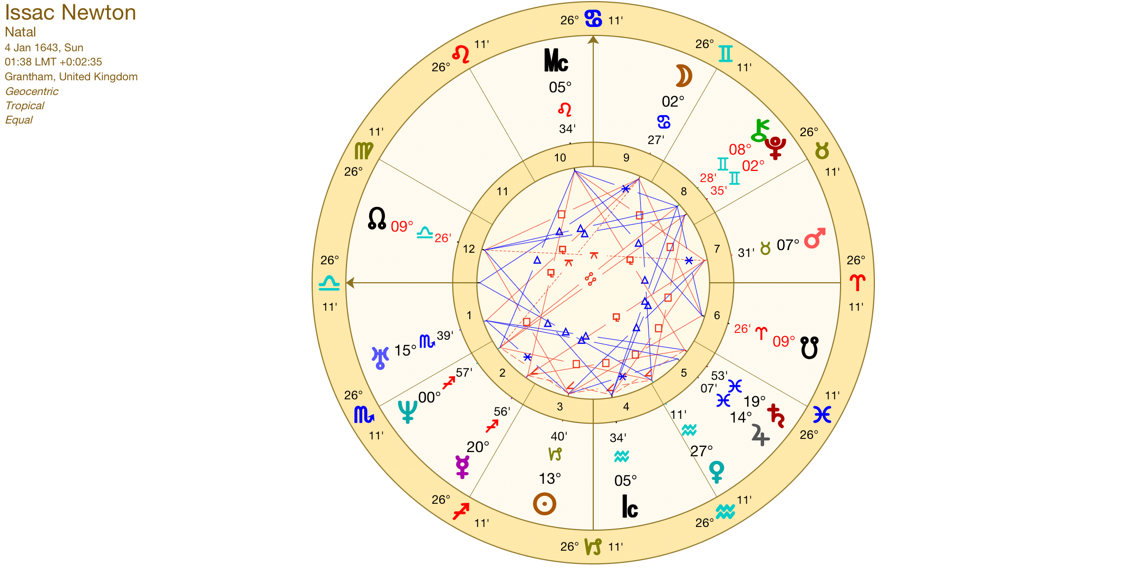
While his Mars in Taurus suggests sensuality, his Venus in Aquarius indicates detached, idealised, and unconventional forms of affection rather than traditional romantic/sexual closeness. An Aquarian Venus can be emotionally cool, and value friendship, intellectual rapport, and humanitarian connection over physical intimacy. This is supported by Neptune in early Sagittarius suggesting a deep longing for ultimate truth rather than earthy sexual encounters.
Newton’s Saturn/ Jupiter (Neptune’s depositor) conjunct in Pisces (traditional ruler of the 12th house) trines Uranus which suggests the archetype of the strategic reformer. Saturn in Pisces is naturally directed toward spiritual, philosophical, or reflective pursuits rather than worldly pleasures such as romance or sexuality. Jupiter, the planet of expansion, vision, and higher learning, amplifies this focus, encouraging deep intellectual and spiritual exploration and a broadening of understanding beyond the material or personal. Uranus adds that brilliance and innovation.
Overall, his chart suggests a temperament that channels natural impulses into higher goals, such as science, philosophy, or introspection, with both discipline andexpansive curiosity. In Newton’s case, this orientation may have been reinforced by his early life experiences: being separated from his mother at a young age left him with a sense of abandonment and emotional isolation (Moon in Cancer), fostering a solitary, introspective nature and a drive toward intellectual and spiritual mastery rather than personal or romantic relationships (Mercury in Sagittarius sesquiquadrate Mars in Taurus)
These signatures tend to be echoed in the lives of many monastics, philosophers, and artists who embrace celibacy or conscious abstinence. For them, sexual desire is neither denied nor seen as a problem. Rather it is channelled into work, creation, or devotion, becoming a source of discipline, insight, and fulfilment. Astrologically, their charts often highlight 12th house, Neptune and Saturn signatures, showing that a life of purpose, creativity, and spiritual or intellectual achievement can thrive without sexual expression.
Sex and ageing
As we explored in the introduction, sexual desire is often portrayed as a universal, unavoidable drive. Yet many people, particularly as they age, experience a natural shift away from libido and toward personal growth, wisdom, and service. As George Melly memorably observed, a fading sexual drive can feel like being ‘unshackled from a lunatic’, a liberation that allowed his attention to flow toward, for him, more meaningful pursuits.iii
In my book Sex, Meaning and the Menopauseiv, a sex therapist described what she wryly called ‘Viagra culture.’ Medical advances mean many older men can continue to perform sexually, which is often celebrated as progress. Of course, many older women are more than happy to enjoy a healthy sex life, but the unspoken consequence is that women are expected to want, enjoy, and physically respond to sex regardless of hormonal shifts, fatigue, bodily changes, or genuine loss of interest.
One woman summed this up simply and pragmatically: ‘I just get on with it. I tell him to pull down my nightie when he’s done.’ There was no drama in her voice, no bitterness. Just practicality. However, she and many other women I spoke with struggle with guilt or shame about their often secret lack of desire.
What’s missing is any serious recognition that many women’s (and men’s come to that) sexual interest genuinely diminishes with age, not because something has broken, but because bodies, priorities, and inner lives evolve.
This is where astrology can offer a way for understanding how sexual energy evolves over a lifetime. Life stages shape how desire is expressed. In youth, libido may appear immediate, impulsive, or exploratory. Mars-driven energy is strong, raw, and focused on self-expression, connection, and discovery. As maturity arrives, this energy often transitions from pursuit to integration as Venus’s influence on harmony and personal values deepens.
The progression of outer planets, Saturn, Uranus, Neptune, and Pluto, highlight cycles of maturing, liberation, and spiritual or psychological integration that often coincide with shifts in sexual focus. Saturn, the teacher of time and structure, can guide ageing sexual energy into meaningful connection rather than impulsive pleasure. With Uranus, sexuality becomes more about liberation from traditional sexual expectations. Neptune channels desire into idealism, spirituality, or creativity, while Pluto drives a deep transformational process about what really matters as we age. Together, these influences illustrate that sexual energy is one of many forces in life, not its sole channel.
Conclusion
Astrology teaches us that sexual desire is neither fixed nor obligatory. It is one expression of our life force among many. As we age and our charts progress, sexual energy naturally shifts, showing that a rich, meaningful and aligned life is possible with or without active sexual expression.
Astrology recognises and affirms the full spectrum of human experience. Some charts express sexual energy strongly and centrally, while others show it manifesting much more quietly in different ways. Libido is a facet of life force – a outlet for energy – but it is not the sum of creativity, fulfilment, or purpose. People may find profound satisfaction in intellectual, spiritual, or communal pursuits, and astrology provides a way for understanding these variations without judgment.
Nor is a life well lived measured by sexual frequency. Rather it is achieved by aligning with your own inner rhythm and authentic self-expression. As Bronnie Ware observed in her research on the five greatest regrets of the dyingv, people did not wish they had more sex; they wished they had found the courage to live a life true to themselves, rather than the life others expected of them.
Ultimately, fulfilment comes from harmony with your own energies, desires, and priorities. Whether sexual desire is abundant, moderate, or absent, the essence of vitality lies in being attuned to your chart and your unique life journey.
i McCluskey, M. (2019, November 5). Emma Watson says she prefers to be called ‘self‑partnered’ rather than ‘single’. TIME. Retrieved from https://time.com/5718757/emma‑watson‑self‑partnered/
ii Schwartz, S. (November 6th 2023). Mars Conjunct Venus: Synastry, Natal, and Transit Meaning. Authority Astrology. https://authorityastrology.com/aspects/mars-conjunct-venus
iii George Melly interview: Arts / Overheard. The Independent, 22 Aug. 1993
iv Sue Brayne, Sex, Meaning and the Menopause. Continuum, 2011
v Bronnie Ware: The Top Five Regrets of the Dying: A Life Transformed by the Dearly Departing. Hay House (original edition published in 2011)